Coaching Series: Practicing Data-Driven Decision Making in the Industry 4.0 Era
Facing the challenges of the digital era, companies are congregating to transform into a data-driven company. However, there are still many misperceptions about this widely discussed phenomenon, especially in the Industry 4.0 era.
SBM ITB welcomed this opportunity through an online public discussion on Saturday, September 19, 2020. This event was the eighth session of the SBM ITB Webinar Series, consistently run by Indonesia’s number one business school.
The event opened with a presentation on the basic concept of data-driven decision-making by the Director of Big Data and Business Analytics Laboratory (Datalab) SBM ITB, Dr. Eng. Manahan Siallagan. His elaboration opened up the insight that humans often use intuition as a tool for decision-making. Unfortunately, it does not always lead to the best expected results.
Conventional thought processes that rely on intuition are humane. However, once we understand these limitations, awareness of transformation is the next step. From discussions with participants, Lidia Mayangsari as moderator concluded that the role of data in decision-making is very significant. It is not to defeat intuitive thinking, but rather to complement and sharpen intuition. When the habit of analyzing data before making decisions is practiced repeatedly, the intuition formed will also become more asserted based on data.
Data-Driven Transformation Starts with People, Not Technology
Manahan Siallagan’s academic substance was strengthened by practical insights from I Made Ariya Sanjaya (CEO Kazee), Bey Arief Budiman (Head of Delivery Yellowfin Indonesia), and Muhammad Apriandito (CEO Technaut).
As one of the leading digital start-up players in Indonesia, Ariya emphasized that to be a data-driven organization, transformation must be applied to human resources first, followed by technological change.
“The data literacy capability of employees should be improved even gradually,” he said.
Another strategy to accelerate data-driven transformation is the transparency of business processes from companies to every department handling data, giving more meaning to the data and accelerating data communication flow.
Data-Driven Strategy Must Be Contextual and Unique
This was reinforced by Bey from Yellowfin Indonesia, who said each company is unique and contextually different.
“This data-driven strategy should be specified for one company. One strategy cannot be applied to all companies because the data input is different, the operating system is different, the culture of the data is different. Unique,” he explained.
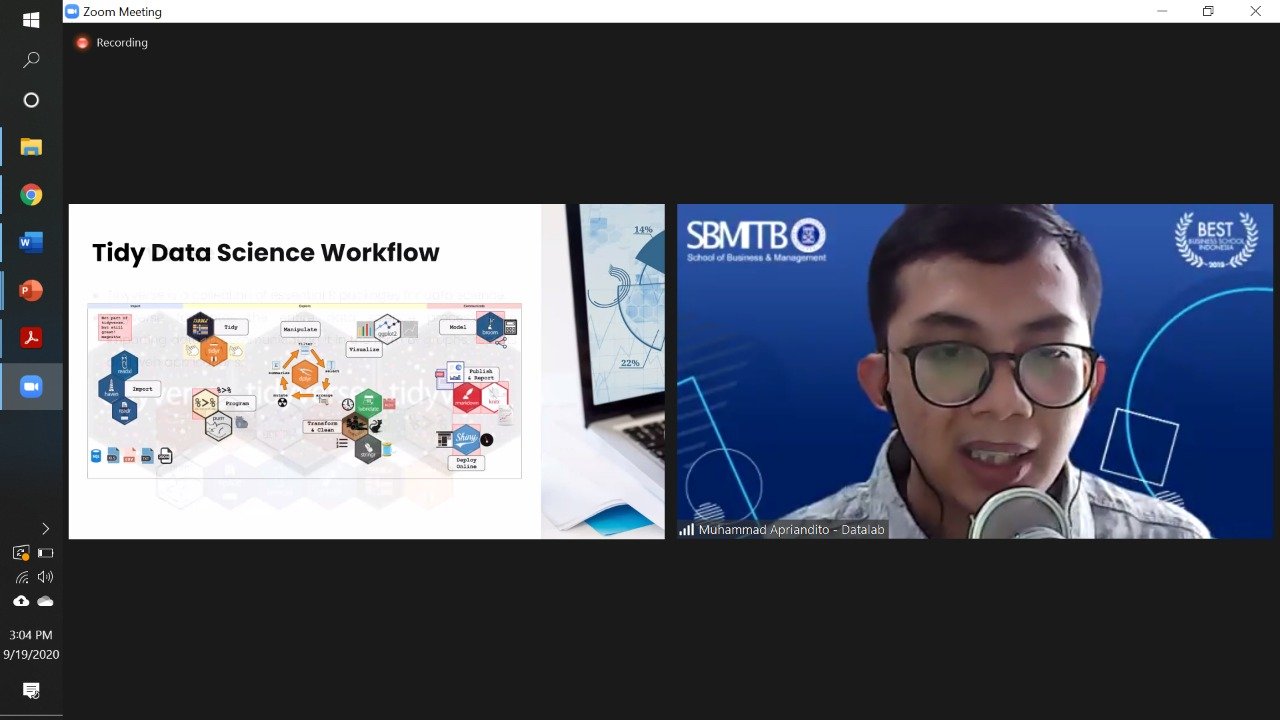
To become a data-driven company, it is a good idea to create an integrated system to simplify analysis and decision-making. Although many software options are available, Apriandito from Technaut, who is also a programmer at Datalab SBM ITB, recommended that companies become familiar with the R programming language.
“R language is very easy, open access, and community-based. This is a plus of R because its supporters are all over the world. It is easy to use, but it is important for us to understand it,” he added.
Having Lots of Data Does Not Necessarily Mean Data-Driven
As closing remarks, the moderator concluded that a company with a lot of data is not necessarily a data-driven company. There are new processes and habituation needed so that both resources and technology can be adaptive to data analysis.
Category
Data-Driven Decision Making, Pengambilan Keputusan Berbasis Data
Published on
Oct 12, 2026
Views
4